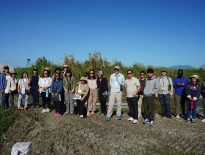

The Society for the Conservation of Philippine Wetlands (SCPW) conducted a three-day Training on Wetland Profiling and Technical Guidance on Wetland Management Planning from 19–21 February 2025 in Bayawan City, Negros Oriental, under the Living Lakes Biodiversity and Climate Project (LLBCP). The activity aimed to strengthen the capacity of local government units (LGUs) to conserve and manage wetlands, particularly in support of the environmental governance indicators of the Seal of Good Local Governance (SGLG).
 The training gathered LGU representatives from Bayawan City and the municipalities of Basay and Sta. Catalina, including environment, disaster risk reduction, agriculture, and tourism officers. On behalf of Mayor John “Jack” T. Raymond, Jr., Mr. Nefredo Villarubia, the City Environment and Natural Resources Officer (CENRO) of Bayawan City, formally welcomed the participants and emphasized the critical role of wetland management in environmental sustainability, climate change adaptation, and disaster risk reduction at the local level. He highlighted the inclusion of wetland management as an indicator under the SGLG as a clear signal of the national government’s commitment to strengthening environmental governance among LGUs.
In his opening message, Mr. Jose Carlo Quintos, Senior Project Officer of SCPW, expressed appreciation to the City Government of Bayawan for proactively organizing the training and underscored SCPW’s commitment to supporting LGUs through technical guidance, capacity building, and community engagement. He emphasized that wetlands provide essential ecosystem services—including water regulation, biodiversity support, and livelihood opportunities—and that strengthening local capacity is key to their long-term conservation.
Key learning sessions covered Wetlands 101, wetland inventory and profiling, and the integration of wetland management into SGLG criteria. Participants were introduced to practical tools such as the Wetland Information Sheet (WIS) and the Rapid Assessment of Wetland Ecosystem Services (RAWES). Dr. Ma. Catriona E. Devanadera, SCPW Trustee and faculty member of the University of the Philippines Los Baños, discussed RAWES as a qualitative assessment tool that captures the ecological, social, and cultural values of wetlands, highlighting the importance of understanding wetland benefits beyond purely economic measures.
 The core component of the training was the Wetland Management Planning which was discussed by Ms. Amy Lecciones, Vice-President and Executive Director of SCPW. The session was anchored on DENR–BMB Technical Bulletin No. 2016-08, a framework originally developed for protected area management planning and adapted during the training for wetland ecosystems. Through field exposure, workshops, and visioning exercises, participants used the framework to identify priority wetlands for protection and management, including the Bayawan River in Bayawan City, the Sicopong River in Sta. Catalina, and the Cot-cot coastal wetland in Basay.

By bringing together local leaders, technical experts, and community representatives, the training demonstrated why capacity-building initiatives like this are crucial to wetland conservation. Strengthening knowledge, collaboration, and local ownership helps ensure that wetlands—our lifeline for water, food, climate resilience, and biodiversity—are protected and sustainably managed for present and future generations