Laguna 
The Society for the Conservation of Philippine Wetlands (SCPW) convened a coordination meeting with the Department of Environment and Natural Resources (DENR) on 24 April 2025 at the DENR Central Office in Diliman, Quezon City to present the midterm progress of the Living Lakes, Biodiversity and Climate Project (LLBCP) and to align on the next steps for its implementation in the Philippines. The meeting aimed to review key accomplishments and challenges, discuss planned activities for 2025, seek policy guidance from DENR, and explore opportunities to scale and replicate successful project components.
The meeting was presided over by Dr. Al Orolfo, Director of the DENR Foreign-Assisted and Special Projects Service, on behalf of Usec. Jonas R. Leones, DENR Undersecretary for Policy, Planning, and International Affai rs and Political Partner Institution of SCPW for the LLBCP. Representatives from SCPW, DENR–FASPS, and the DENR Biodiversity Management Bureau (BMB) participated in the discussion, reflecting continued inter-agency collaboration in advancing wetland conservation and climate action.
 During the project briefing, Ms. Amy Lecciones, Executive Director of SCPW, presented the overall progress of the LLBCP, highlighting SCPW’s leadership in implementing capacity-building initiatives, international knowledge exchanges, and on-the-ground conservation actions. She discussed the Frontrunner Initiative at the Paligui Wetlands in Candaba, Pampanga, which promotes sustainable farm tourism and ecosystem-based management, and the Showcase Project—the Green Filters Facility at the Panguil River Ecopark in Pangil, Laguna. The Green Filters Facility serves as a nature-based solution for treating wastewater before discharge into nearby water bodies, contributing to pollution reduction in Laguna de Bay.
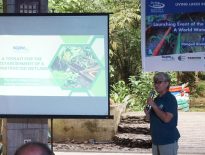
Ms. Lecciones also outlined implementation challenges encountered during construction, commissioning, and pilot-testing, as well as the measures adopted by SCPW to address these issues. These included direct project management interventions, strengthened partnerships with local government units, and institutionalization efforts through local policy support. To support wider adoption, SCPW also developed the Green Filters Replication Toolkit, which provides guidance for other LGUs interested in implementing similar nature-based wastewater treatment systems.

In response, Dr. Orolfo commended SCPW for the tangible improvements achieved at project sites and emphasized the importance of sustaining strong partnerships with LGUs and stakeholders. He expressed support for scaling SCPW-led initiatives, including the possible replication of the Green Filters Facility in other protected areas through the BMB, and underscored the value of inclusive and intersectional approaches in future activities. The meeting concluded with a shared commitment to advance coordinated actions that protect wetlands—our lifeline for water security, biodiversity, our ally in climate resilience, and community well-being—through science-based, people-centered, and scalable conservation solutions led by the SCPW with the help of the Living Lakes Network and the International Climate Initiatives (IKI).